
The Texas Virtual School Network (TXVSN) provides a statewide course catalog of supplemental online courses for credit toward high school graduation. Since its inception in January 2009, the TXVSN has provided Texas students and schools with a valuable avenue for interactive, collaborative, instructor-led online high school-level courses taught by state-certified and appropriately credentialed teachers trained in effective online instruction.
Established by the Texas Legislature to provide students with equitable access to quality, supplemental online courses, the TXVSN course catalog offers students across the state opportunities to enroll in high school, Advanced Placement, and dual credit courses provided by eligible school districts, open-enrollment charter schools, regional education service centers (ESCs), institutions of higher education, and private and nonprofit providers. TXVSN course providers submit courses for inclusion in the catalog and are responsible for instruction. Each course is expected to have and is reviewed for 100% alignment to the Texas Essential Knowledge and Skills (TEKS), International Association for K-12 Online Learning’s (iNACOL) National Standards for Quality Online Courses, and accessibility guidelines. The TXVSN is a network of providers that operates a supplemental rather than diploma-granting program. Providers work in partnership with a student’s home district, known as a receiver district, to meet students’ needs. Each receiver district awards credits and diplomas and remains accountable for the student’s academic progress. School personnel, students, and parents can review options to select online courses that best meet students’ needs.
Statute authorizes the commissioner of education to contract with an education service center (ESC) to operate the network. ESC Region 10 currently serves as central operations for the TXVSN and is responsible for managing all systems used to operate the network, providing and maintaining TXVSN telecom and infrastructure, managing course review, and coordinating activities with course providers, receiver districts, and other stakeholders.
Receiver districts are required to pay the course cost of TXVSN courses for public school students who are taking courses within a normal course load of seven yearlong courses, but may decline to pay the course costs for more than three yearlong TXVSN courses or the equivalent. Districts and charter schools are eligible to receive Foundation School Program (FSP) funding for up to three yearlong TXVSN courses, or the equivalent, that are successfully completed.
Enrollment statistics, a list of current high school and dual credit course providers, and the course catalog may be reviewed at www.txvsn.org by selecting the Course Catalog link.
Texas Education Code Chapter 30a defines eligible TXVSN statewide catalog course providers as
A nonprofit entity, private entity, or corporation is eligible to act as a course provider under this chapter only if the nonprofit entity, private entity, or corporation:
An entity other than a school district or open-enrollment charter school is not authorized to award course credit or a diploma for courses taken through the state virtual school network.
Online courses included in the TXVSN statewide course catalog must meet the basic definitions set forth by Senate Bill 1788 and Texas Education Code Chapter 30A. Online courses are defined as follows:
Courses must be equivalent in instructional rigor and scope to a course offered in the traditional classroom. The courses to be reviewed by TXVSN for grades 9-12 shall include a full range of course options that are needed to complete current high school graduation requirements as found in 19 Texas Administrative Code (TAC) Chapter 74.
Before applying to be a statewide course catalog provider, an eligible entity should conduct an internal review of its course(s) to verify that each meet the definition above and is in 100% alignment with Texas Essential Knowledge and Skills (TEKS), International Association for K-12 Online Learning’s (iNACOL) National Standards for Quality Online Courses, and accessibility guidelines. The standards used to review courses are available at http://txvsn.org/providers/standards/
After completing component 1 of the provider application process and receiving approval of the application by an email to the contact supplied on the application, the potential catalog provider will submit its course(s) via the TXVSN Electronic Course Submission System (ECSS). The applicant will supply general course information such as course name, PEIMS numbers, semesters, contact information, technical requirements, and TEKS alignment in the ECSS format. In addition, TXVSN Course Review will need course access and login information as two reviewers will be assigned to log into the course and then verify its 100% alignment with the Texas Essential Knowledge and Skills (TEKS), the International Association for K-12 Online Learning’s (iNACOL) National Standards for Quality Online Courses, and accessibility guidelines.
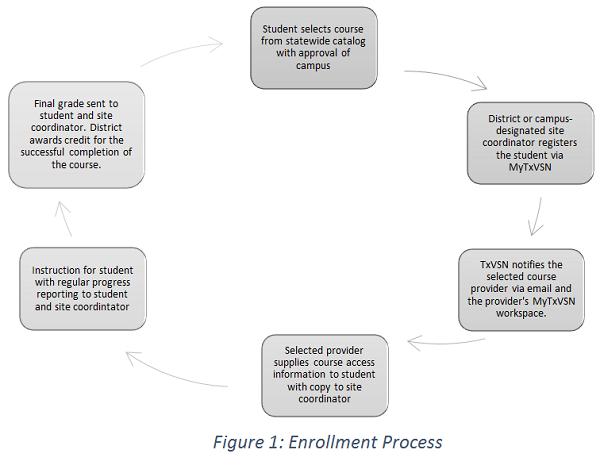
TEC §30A.105 specifies that the amount of the cost charged for a semester course provided through the state virtual school network may not exceed $400. Courses offered through the TXVSN statewide course catalog must be offered at a price that does not exceed the lowest price at which the course is offered for use or sale to any state, public school, school district, or chartered school in the United States. The price of any course or item or service for the course must automatically be reduced to the extent that, and at the same time as, the price is reduced or offered elsewhere in the United States. A course or item or service for the course must be provided free of charge or at a price discount to the same extent that it is provided to any state, public school, school district, or chartered school anywhere in the United States.
Each semester, on a scheduled provided by TXVSN operations, a provider reconciles student enrollment data in the provider’s MyTXVSN workspace to indicate if students completed courses successfully, unsuccessfully or or dropped. Based on this reconciliation, the course provider is paid 100 (one hundred) percent of the catalog course cost if the student successfully completes the course, but no more than 70 (seventy) percent of the catalog course cost if the student is unsuccessful. If a student dropped during the drop period, then his district is held harmless for the course cost.
After posting reconciled data to MyTXVSN, the course provider invoices Central Operations each for course. Central Operations in turn, invoices the students’ districts or charters for the course cost based on the reconciled semester enrollment data.